
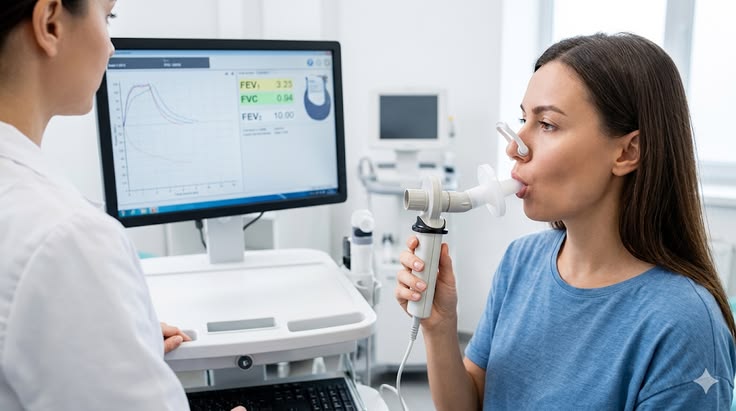
PFT Test in OMR
Pulmonary Function Testing at AVR Scan Centre
If your doctor has recommended a PFT Test in OMR, you may want to know what the test measures, why it is recommended, how to prepare, and what happens during the examination.
PFT, or Pulmonary Function Test, is a group of breathing tests used to assess how well the lungs are working. Depending on the type of test performed, PFT can provide information about airflow and how effectively the lungs move and handle air.
PFT may be recommended when a doctor is evaluating symptoms such as breathlessness, persistent cough, wheezing, or other respiratory concerns , or when monitoring an existing lung condition.
AVR Scan Centre provides PFT services for patients looking for respiratory diagnostic testing in and around the OMR region.
Before your appointment, follow the instructions provided for your specific test and inform the healthcare team about relevant medical conditions and medications.
What is a PFT Test?
A Pulmonary Function Test is a breathing test used to assess how well the lungs and respiratory system are functioning.
PFT can provide information about breathing patterns and lung function. The exact measurements depend on the type of pulmonary function test performed.
One of the commonly used tests is spirometry, which measures how much air you can breathe out and how quickly you can breathe it out.
Depending on the clinical requirement, pulmonary function testing can help a doctor assess respiratory function and understand whether further evaluation may be needed.
Quick Answer
- PFT= Pulmonary Function Test
- Purpose: To evaluate lung and breathing function
- Common component: Spirometry
- Who recommends it: A qualified healthcare professional based on your symptoms or clinical requirement
PFT Test in OMR – Where Can You Get a Pulmonary Function Test?
If you are searching for a PFT Test in OMR, AVR Scan Centre provides PFT services for patients in and around the OMR region.
AVR Scan Centre – Sholinganallur
First Floor, No. 278/1 & 278/2, Commercial Building, Ramanyam Pushkar 2, Kalaignar Karunanidhi Salai, Sholinganallur – 600119.
Patients travelling from nearby areas such as Padur, Navalur, Siruseri, Kelambakkam, Thiruporur and surrounding OMR localities can contact the centre before visiting to confirm:
- PFT availability
- Appointment requirements
- Preparation instructions
- Any specific instructions for the prescribed test
The exact pulmonary function test required should be based on your doctor's recommendation.
Why Might a Doctor Recommend a PFT?
A doctor may recommend a PFT when lung function needs to be evaluated as part of a respiratory assessment.
PFT may be considered when a patient has symptoms such as:
- Shortness of breath
- Persistent cough
- Wheezing
- Reduced exercise tolerance
- Other breathing-related concerns
PFT may also be used when a doctor needs objective information about lung function or wants to monitor an existing respiratory condition.
The test selected depends on the patient's symptoms, medical history, and the clinical question being investigated.
What Does a PFT Measure?
A PFT can provide measurements related to airflow and lung function, depending on the specific test performed.
For example, spirometry can measure:
- Forced Vital Capacity (FVC): The amount of air that can be forcefully exhaled after taking a deep breath.
- Forced Expiratory Volume in 1 Second (FEV1): The amount of air exhaled during the first second of a forced breath.
- FEV1/FVC ratio: The relationship between these two measurements, which can help healthcare professionals assess airflow patterns.
The meaning of these measurements depends on the patient's age, sex, height, symptoms, and other clinical factors.
A PFT report should be interpreted by a qualified healthcare professional rather than evaluated in isolation as a single number.
How is a PFT Test Performed?
A PFT is performed by having the patient breathe into a specialized device that records airflow and other measures of lung function.
For a basic spirometry test, the process generally includes:
- You will be seated comfortably and given instructions by the healthcare professional.
- A mouthpiece is placed in your mouth.
- You will usually be asked to breathe normally for initial measurements.
- You may then be asked to take a deep breath and exhale as forcefully and completely as instructed.
- The test may be repeated to obtain consistent measurements.
Following the breathing instructions carefully is important because the quality of the results depends on how the test is performed.
What Happens During a PFT?
A PFT is a breathing-based diagnostic test, so your active participation is important.
During the test, the healthcare professional may ask you to:
- Breathe normally
- Take a deep breath
- Exhale forcefully
- Continue exhaling for the required duration
- Repeat the manoeuvre when necessary
You may feel temporarily tired or slightly light-headed after repeated forceful breathing. Tell the healthcare professional if you feel unwell or need a break.
The test itself does not usually involve injections or surgery.
How Should You Prepare for a PFT Test?
PFT preparation can vary depending on the type of pulmonary function test and your individual circumstances.
Follow the Centre's Instructions
Ask the centre whether you need any specific preparation before the test.
Wear Comfortable Clothing
Choose clothing that does not make breathing or chest movement uncomfortable.
Tell the Healthcare Team About Your Medications
Some medicines, particularly certain inhaled medications, may affect pulmonary function measurements.
Do not stop or change any prescribed medication on your own. Ask your doctor or the testing centre whether any medication needs to be adjusted before your examination.
Avoid Heavy Activity Before the Test
Your healthcare team may provide instructions about exercise or other activities before testing, depending on the examination being performed.
Avoid Smoking Before Testing
Smoking can affect respiratory measurements. Follow the instructions provided by your healthcare professional before the test.
Can I Eat Before a PFT Test?
PFT does not always require fasting, but preparation instructions can vary depending on the type of test.
A very heavy meal immediately before testing may make forceful breathing uncomfortable for some people.
Follow the specific instructions provided by the testing centre or your healthcare professional rather than assuming that fasting is required.
Can I Take My Inhaler Before a PFT?
Do not stop using an inhaler or other prescribed respiratory medication unless your doctor or testing centre specifically instructs you to do so.
Some pulmonary function tests are performed before and after a bronchodilator, while medication instructions can vary depending on the purpose of the test.
Before your appointment, tell the healthcare team about:
- Inhalers
- Asthma medication
- COPD medication
- Other respiratory medicines
- Any recent changes in treatment
This helps the testing team interpret the test appropriately.
is a PFT Test Safe?
PFT is generally a non-invasive test, but repeated forceful breathing can temporarily cause tiredness, coughing or light-headedness in some people.
Tell the healthcare professional before testing if you have:
- Significant breathing difficulty
- Recent chest pain
- Recent surgery
- A recent heart-related problem
- A condition that may make forceful breathing difficult
Your healthcare professional can determine whether testing is appropriate and whether any precautions are needed.
is a PFT Test Painful?
PFT is generally not painful.
The test involves breathing into a mouthpiece and following breathing instructions.
Some people may experience temporary:
- Coughing
- Tiredness
- Chest discomfort from repeated forceful breathing
- Light-headedness
If you feel uncomfortable during the test, inform the healthcare professional conducting the examination.
How Long Does a PFT Test Take?
The duration of a PFT depends on the type of pulmonary function test being performed and the number of measurements required.
A basic breathing test may be relatively brief, while more comprehensive pulmonary function testing can take longer.
The centre can provide the expected duration of your appointment for your specific test.
What Can a PFT Test Help Evaluate?
A PFT can provide objective information about how well the lungs and respiratory system are functioning.
Depending on the type of pulmonary function test, the results may help a doctor assess airflow and other aspects of breathing function.
PFT may be considered when evaluating respiratory concerns associated with conditions such as:
- Asthma
- Chronic obstructive pulmonary disease (COPD)
- Persistent breathing difficulties
- Long-term cough or wheezing
- Other suspected lung-function problems
PFT results are interpreted together with the patient's symptoms, medical history and clinical findings.
What is Spirometry?
Spirometry is one of the most commonly used pulmonary function tests and measures how much air you can breathe out and how quickly you can exhale it.
Two commonly discussed spirometry measurements are:
- FEV1: The volume of air forcefully exhaled during the first second of the test.
- FVC: The total amount of air forcefully exhaled after taking a deep breath.
- The FEV1/FVC ratio: Provides information about airflow.
These numbers should not be interpreted independently. A healthcare professional considers the patient's age, height, sex, symptoms, medical history and other relevant factors when interpreting the results.


Can a PFT Help Diagnose Asthma or COPD?
PFT can provide information that helps doctors evaluate conditions such as asthma and COPD, but the test is interpreted together with the patient's overall clinical picture.
For example, breathing tests may help identify patterns of airflow limitation.
In some situations, a doctor may compare breathing measurements before and after a bronchodilator to assess changes in airflow.
A PFT result alone does not establish a diagnosis. Your doctor determines the diagnosis based on the complete clinical evaluation.
What Do PFT Results Mean?
PFT results contain numerical measurements that describe different aspects of lung function.
Depending on the test, the report may include measurements such as:
- FEV1
- FVC
- FEV1/FVC
- Other pulmonary function measurements
Results are commonly compared with expected values based on factors such as age, height and sex.
A result outside a reference range does not automatically mean that you have a specific disease. The significance of the findings depends on the complete clinical context.
If you receive a PFT report, ask your doctor to explain the results rather than trying to diagnose yourself from individual numbers.
What Happens If the PFT Result is Abnormal?
An abnormal PFT result does not automatically identify a single condition.
Depending on the findings and your symptoms, your doctor may recommend:
- Repeat pulmonary function testing
- Additional respiratory evaluation
- Imaging such as a chest X-ray or CT when appropriate
- Further clinical assessment
- Changes or continuation of treatment
The next step depends on the individual patient's clinical situation.
Who May Need a PFT Test?
A doctor may recommend PFT when a patient has symptoms or a medical history that requires objective assessment of lung function.
Examples include people experiencing:
- Breathlessness
- Persistent cough
- Wheezing
- Reduced exercise tolerance
- Recurrent respiratory symptoms
PFT may also be useful when a doctor needs to evaluate or monitor a known respiratory condition.
The decision to perform the test should come from a qualified healthcare professional based on the patient's circumstances.
PFT Test vs Chest X-Ray – What is the Difference?
PFT and chest X-ray provide different types of information.
| PFT | Chest X-Ray |
|---|---|
| Evaluates aspects of lung function and airflow | Produces an image of structures in the chest |
| Involves breathing into a testing device | Uses X-rays to create an image |
| Provides numerical measurements | Provides anatomical imaging |
| Can help assess airflow patterns | Can help evaluate selected chest and lung abnormalities |
Which one do I need?
That depends on what your doctor needs to evaluate.
A PFT and chest X-ray are not substitutes for each other and may sometimes be recommended together.
When Should You Consult a Doctor About Breathing Problems?
Persistent or worsening breathing symptoms should be discussed with a qualified healthcare professional.
Seek medical evaluation for concerns such as:
- Ongoing shortness of breath
- Persistent cough
- Recurrent wheezing
- Reduced ability to perform usual activities
- Other unexplained respiratory symptoms
A PFT may be one part of the evaluation, depending on the clinical situation.
Why Choose AVR Scan Centre for a PFT Test in OMR?
When choosing a PFT Centre in OMR, patients may want to consider the location, availability of the required test, preparation requirements, and appointment process.
AVR Scan Centre provides PFT services for patients requiring pulmonary function testing.
PFT Service
Patients can enquire about the pulmonary function test recommended by their doctor.
Sholinganallur Location
The Sholinganallur centre provides an option for patients looking for diagnostic services around the OMR region.
Multiple Diagnostic Services
AVR Scan Centre also provides diagnostic services including:
- MRI Scan 1.5T
- Multi-Slice 3D Spiral CT Scan
- Ultrasound
- X-Ray
- 3D/4D Obstetrics
- Computerized ECG
- Echocardiogram
- SonoMammography
- Treadmill Test
- EEG
- Lab Services
- Preventive Master Health Checkup
- Digital Mammogram
- OPG
What Should You Check Before Booking a PFT in OMR?
Before scheduling your PFT, confirm:
- Which pulmonary function test your doctor has recommended
- Whether any preparation is required
- Whether you should continue your usual medicines or inhalers
- Whether previous respiratory reports should be brought
- Appointment availability
- Any instructions specific to your test
Do not stop prescribed respiratory medication without medical advice.
Frequently Asked Questions About PFT Test in OMR
A PFT, or Pulmonary Function Test, is a breathing test used to assess how well the lungs and respiratory system are functioning. Spirometry is one of the commonly used components of PFT.
AVR Scan Centre provides PFT services for patients looking for pulmonary function testing in and around the OMR region. Contact the centre to confirm availability and appointment requirements.
PFT is generally non-invasive and is not usually painful. You will need to follow breathing instructions, including taking deep breaths and exhaling forcefully.
Fasting is not necessarily required for every PFT. Preparation can vary, so follow the instructions provided by the testing centre or your healthcare professional.
Do not stop or change prescribed medication on your own. Ask your doctor or testing centre whether any inhaler or respiratory medication needs to be adjusted before the test.
The duration depends on the type of pulmonary function test and the measurements required. A basic test may be relatively brief, while more comprehensive testing may take longer.
Depending on the test, PFT can provide measurements related to airflow and lung function. Spirometry commonly includes measurements such as FEV1, FVC and the FEV1/FVC ratio.
Bring your doctor's prescription or referral, relevant previous reports if available, and information about the medicines or inhalers you currently use.
Get Your PFT Test at AVR Scan Centre, Sholinganallur
If your doctor has recommended pulmonary function testing, understanding what the test measures, how to prepare, and how the results are interpreted can help you approach the examination with confidence.
AVR Scan Centre provides PFT services for patients looking for pulmonary function testing in and around OMR.
Before visiting, contact the centre to confirm:
- Your required PFT
- Availability
- Preparation instructions
- Appointment requirements
Contact AVR Scan Centre – Sholinganallur to enquire about the PFT recommended by your doctor, preparation requirements and appointment availability.
AVR Scan Centre – Sholinganallur
First Floor, No. 278/1 & 278/2, Commercial Building,
Ramanyam Pushkar 2, Kalaignar Karunanidhi Salai,
Sholinganallur – 600119.
